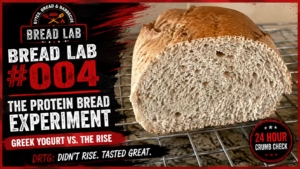
Testing ideas, measuring results, and occasionally discovering
that the yeast has ignored the schedule completely.
Every loaf begins with a question.
Some bakers follow recipes exactly as written.
I admire those people.
I usually get halfway through a loaf and begin wondering what
would happen if I changed the flour, added a preferment, adjusted
the hydration, tried another piece of equipment—or simply gave
the dough more time to do what dough does.
Bread Lab is where those questions become experiments.
Each Case File documents the idea, the method, the measurements,
the photographs, the taste test, and the final verdict.
Sometimes the experiment succeeds. Sometimes the bread humbles me.
Either way, you will see what actually happened.
Inside the Laboratory
Bread Lab is not a collection of perfect recipes handed down
from somewhere high atop a flour-covered mountain.
It is a working notebook. The successes stay. The failures stay.
The unexpected three-hour proofing times stay.
Every case starts with a question and ends with an honest
assessment: What changed? What worked? What did not?
Did the bread taste better? And, most importantly,
would I bake it again?
“Bread Lab isn’t about making promises.
It’s about asking good questions.”
The Bread Lab Principle
The Bread Lab Method
1
Ask a Question
Every experiment begins with something worth investigating.
2
Form a Plan
Choose the ingredients, equipment, and method being tested.
3
Record Everything
Times, temperatures, weights, texture, rise, and the
occasional surprise.
4
Taste Everything
Because a technically impressive loaf still needs to be
worth eating.
5
Report Honestly
Success, failure, or “promising, but please pass the butter.”
Laboratory Rules
✓
Show the Process
Good results are useful. Knowing how we reached them
is even better.
✓
Measure What Matters
Dough temperature, fermentation time, weight, spring,
crumb, and flavor all belong in the notebook.
✓
Respect the Evidence
A good-looking loaf does not prove a health claim,
and a nutrition label cannot answer every question.
✓
Admit the Surprises
Bread rarely reads the schedule. Sometimes that is where
the best part of the story begins.
✓
Keep Failed Experiments
A disappointing loaf can still teach us what to change
next time.
✓
Always Conduct a Taste Test
Preferably after the loaf has cooled—although compliance
may vary.
No Miracle Bread Claims
Bread Lab may investigate whole grains, fermentation, fiber,
sweeteners, or other recipe changes, but an experiment in my
kitchen is not a clinical trial.
I will distinguish between what a recipe was designed to do,
what I observed, and what the evidence actually proves.