The Busser Family Cookbook

Preserving over a century of family recipes, memories, and the women who wrote them.

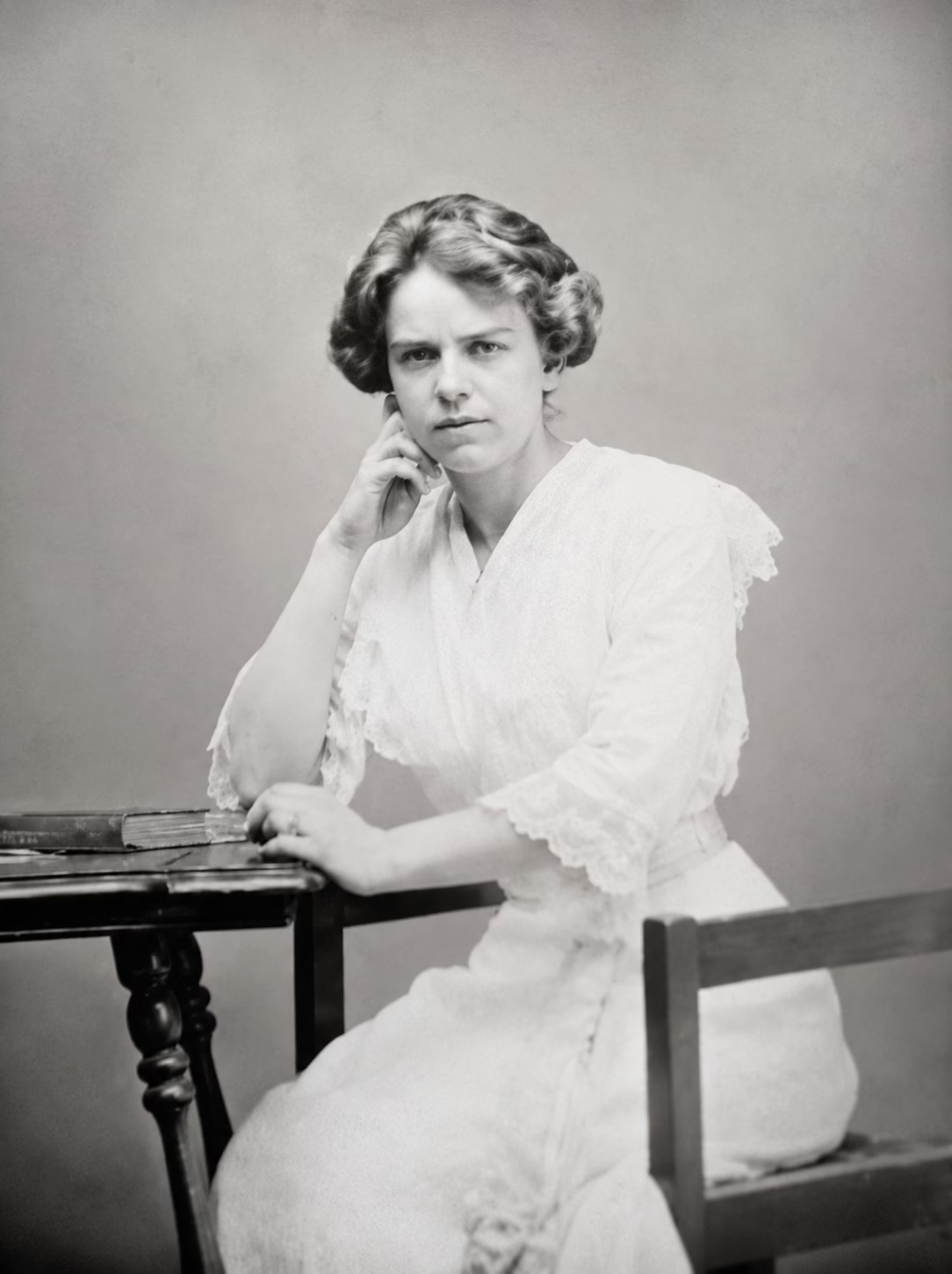
My grandmother, Helen Victoria Martin Busser, was born on October 13, 1888, and passed away on May 12, 1976. Among the many things she left behind was a small handwritten composition notebook simply labeled with recipes she collected “when I took up housekeeping.”

Today, that little notebook is nearly a century old. Its cover is worn, its pages are fragile, and traces of flour, grease, and faded ink tell the story of countless meals prepared for family and friends over decades. Rather than allow those pages to continue fading with time, I wanted to preserve them for future generations.

The recipes appear to span the early 1900s through 1968, when my grandmother moved into my parents’ home. They are presented here in the same order as they appear in her original notebook. Some pages contain a single recipe, others two or three, and there seems to have been no attempt at organizing them. Cakes may be followed by pickles, cookies by soups, and desserts by bread. That’s part of the notebook’s charm.

Many recipes consist only of ingredient lists with few, if any, instructions. Measurements are sometimes vague, handwriting occasionally difficult to read, and several pages still carry dustings of flour or ink smudges from decades of use. I have transcribed each page as faithfully as possible while preserving the character of the original notebook.

One of the most fascinating discoveries has been learning more about the women whose names appear throughout these pages. They were not famous cookbook authors but neighbors, relatives, and friends who freely shared recipes long before the internet, television cooking shows, or food blogs. Their names became part of our family’s culinary history.

As my research continues, I plan to add the stories behind these recipes, identify the women who contributed them whenever possible, and document my family’s attempts to recreate dishes that have nearly disappeared with time. Some experiments have been wonderfully successful, while others—like my mother’s legendary “Oat Flakes” cookies—continue to challenge us.

I hope you’ll enjoy exploring this little piece of our family’s history as much as I’ve enjoyed preserving it.

Meet the Author

Helen Victoria Martin Busser

Helen Victoria Martin Busser was born in East Prospect, York County, Pennsylvania, where she grew up on a large family farm. Family lore tells us that she was engaged as a young woman, but her fiancé was killed during World War I. In those days, an unmarried woman beyond the traditional marrying age was often considered an "old maid."

Rather than remain on the family farm, Helen chose a remarkably independent path. She moved to York and supported herself as a telephone operator during the early years of widespread telephone service—a modern profession at a time when relatively few women lived on their own. While many of her friends became active in the Woman's Christian Temperance Union (WCTU), Helen was known to enjoy a good Manhattan. Family photographs even show her dressed in fashionable flapper clothing during the 1920s, reflecting a spirited personality and a willingness to embrace the changing times.

In 1924, she married Charles Henry Busser Sr. Family lore doesn't tell us exactly how they met, but Charles was considered an "old bachelor" who worked as a print setter. He was 43 years old when they married, while Helen was 36—ages that were considered quite late for a first marriage in that era.

Helen remained an independent woman throughout her life. Both she and Charles continued working while raising their family, something that was far less common at the time than it is today. Before starting her family, my grandmother worked as a waitress at F. H. Bierman & Son on Cleveland Avenue in York, Pennsylvania. Bierman's was a well-known York restaurant, famous for its homemade ice cream, oysters, seafood, and hearty family meals. One day, while working there, she jotted down this Brown Cake recipe on an unused Bierman's restaurant invoice—a simple act that unknowingly preserved a piece of our family's culinary history. The recipe for Brown Cake, reproduced in the downloadable transcription, still appears exactly as she jotted it down:

"2 cups sugar, 1 cup butter & lard, 4 eggs, pinch of salt, 1 cup sour milk, 1 teaspoon baking soda, 1 teaspoon cinnamon, ½ teaspoon cloves, 1 cup raisins, 1 cup nuts, 2½ cups flour."

According to my mother, Helen and Mrs. Bierman became close friends. The Bierman family loaned my grandparents the money to purchase their first home together and even gave them a complete bedroom suite as a wedding gift. My mother remembered that friendship lasting throughout their lives.

In 1968, Helen came to live with my parents, and it is at that point that the story contained within her handwritten cookbook comes to an end. My hope is that this Family Cookbook Project will continue where her notebook leaves off—adding recipes from my mother, preserving new family stories, researching the women who shared their recipes with Helen, and documenting my own attempts to recreate these treasured dishes for future generations.
The Cookbook


Nearly 100 years old

Original handwritten pages

100+ family recipes

Faithfully transcribed

The Women Behind the Recipes

The recipes in my grandmother's notebook didn't come from a single source. Like many home cooks of her generation, she collected recipes from family, friends, neighbors, and coworkers. Together they tell the story of a community where recipes were shared one kitchen at a time.

Name Relationship & Story
Mrs. Beck Neighbor of my grandmother when she lived on Prospect Street in York, Pennsylvania. As my 93-year-old mother recalls, "She seemed really old when I was a little girl... maybe sixty!"
Mrs. French Neighbor when my grandparents lived on Market Street in York, Pennsylvania.
Aunt Helen Zarfoss Sister of my great-grandmother, Katie Jemma Burg Martin, making her my grandmother's aunt.
Aunt Mary Stough Maternal aunt of my grandfather, Charles Henry Busser Sr. After his mother died when he was only 18 months old, she and her husband, who had no children of their own, raised him as their son.

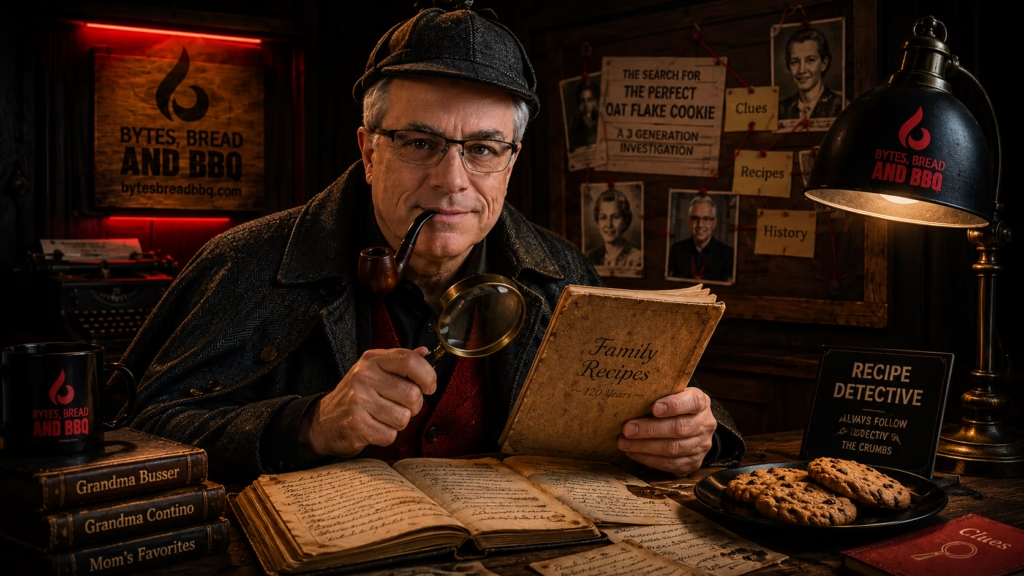
The Recipe Detective Project

Every family has that one recipe everyone remembers… but no one can quite recreate.

While talking with my 96-year-old mother one afternoon, I mentioned a cookie from my childhood that I had been craving for years. We both remembered it vividly—soft, chewy, with an almost caramel or toffee-like top—but neither of us could remember exactly how it was made. The recipe had simply vanished with time.

Naturally, I did what any reasonable person would do…

I became a Recipe Detective.

My investigation started with one clue: “Oat Flake Cookies.” There was just one problem.

Post Oat Flakes cereal no longer exists.

At first I thought the trail had gone cold. Then I remembered something else from my childhood—the cereal box itself. It was made by Post, and if my memory was correct, there was a smiling cookie on the front of the box.

That tiny clue changed everything.

Soon I was digging through old advertisements, television commercials, vintage cereal boxes, and forgotten recipes scattered across the internet. I even uncovered a 1961 recipe printed on the side of the original Post Oat Flakes box.

Unfortunately…

It wasn’t my mother’s cookie.

The recipe was close, but not close enough. Then I noticed something unexpected in the ingredient list:

Malt flavoring.

Suddenly, a light bulb went on. That distinctive flavor I remembered wasn’t coming from the oats at all—it was coming from the malt.

That’s when modern technology entered a very old mystery.

I gathered every clue I could find—family memories, vintage advertisements, ingredient lists, old recipes, photographs, and cereal box labels—and turned them over to AI.

Together we began building a theory.

Since today’s grocery stores no longer sell Post Oat Flakes, AI suggested that Special K might provide a similar malt flavor, while combining it with old-fashioned oats could recreate both the texture and taste I remembered.

Then came the most important part of any investigation…

The experiment.

The first batch came out of the oven, and my wife and I took our first bites.

The verdict?

The taste was remarkably close—close enough that my wife immediately said, “They taste just like your mother’s.”

But there was still one missing clue.

My mother’s cookies had a flatter, slightly crisp, almost toffee-like top. Ours were a little thicker and more like traditional oatmeal cookies.

So…

The case remains open.

The next experiment will reduce the flour slightly while increasing the butter and brown sugar. Maybe that’s the missing piece of the puzzle.

Or maybe another clue is still waiting to be discovered.

Either way…

The investigation continues.


🕵️ Recipe Detective Status

Case: The Missing Oat Flake Cookie

✅ Original cookbook located

✅ Vintage advertisements recovered

✅ 1961 cereal box recipe discovered

✅ AI reconstruction completed

✅ First baking experiment successful

🔎 Current Status: Case still open…

Stay tuned. There are more family mysteries to solve.

Continue Your Journey

🏠 Welcome

📚 Browse All Family Recipes

🕵️ The Mystery of Mary’s Oat Flake Cookies

👩 Grandma Busser’s Original Cookbook

🍞 Modern Tested Versions

❤️ Share Your Own Family Recipe

🏠 Return to Bytes, Bread & Barbecue