

“Good bread takes time.”
If you’ve baked bread for any length of time, you’ve heard that saying more than once.
We’re told that great bread needs overnight fermentation, stretch-and-folds, long proofing times, maybe even a night in the refrigerator. Good bread, we’re told, is a marathon—not a sprint.
So when I stumbled across a YouTube video claiming I could make fresh homemade sandwich bread in one hour, my first thought was:
“Yeah…sure.”
Then reality stepped in.
It was Sunday morning.
I woke up ridiculously early because, apparently, my internal alarm clock has decided retirement means 5:00 AM is sleeping in.
While wandering around the kitchen waiting for the rest of the house to wake up, I remembered my wife had mentioned she wanted BLTs for lunch.
There was only one problem.
We were completely out of bread.
Suddenly this wasn’t just another interesting YouTube video.
It was a mission.
If you’re new to bread baking, my free Bread Baker’s Toolbox takes the guesswork out of adjusting recipes and scaling ingredients.
The Experiment
Even though I’ve built several bread calculators for Bytes, Bread & Barbecue, I’m always watching bakers with more experience than I have. One of those channels is Robyn on the Farm, and her “1 Hour Bread” recipe immediately caught my attention.
Rather than simply copying her recipe here (she deserves full credit for creating it), I wanted to answer one question:
Can you really make good sandwich bread in only one hour?
There was only one way to find out.
Bread Nerd Meter
Mess Factor: ⭐⭐⭐⭐⭐
Difficulty: ⭐☆☆☆☆
Patience Required: ⭐☆☆☆☆
Likelihood I’ll Make It Again: ⭐⭐⭐⭐⭐
Likelihood My Wife Will Ask Me To Make It Again: The scale wasn’t designed to go that high.
First Surprise: My Kitchen Stayed Clean
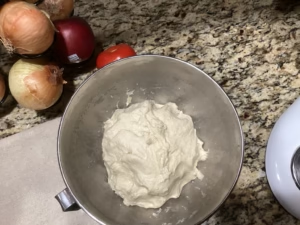
The recipe came together almost effortlessly.
Everything went into the stand mixer, I attached the dough hook, and five minutes later I had a smooth dough.
Even better?
My hands never became one giant ball of sticky dough.
If you’ve ever wrestled with a high-hydration dough that seemed determined to become part of your fingerprints forever, you’ll understand why this felt almost magical.
Second Surprise: Twenty Minutes Later…
This was the moment I stopped being skeptical.
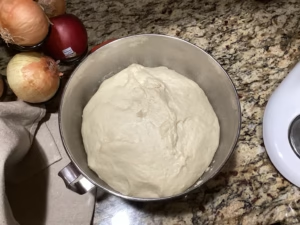
The recipe called for a single 20-minute rise.
Twenty minutes.
I’ve spent longer deciding what to watch on Netflix.
Yet when I came back, the dough had nearly doubled in size.
I actually looked twice because I thought I was imagining things.
Shaping Took Longer Than Finding My Loaf Pans
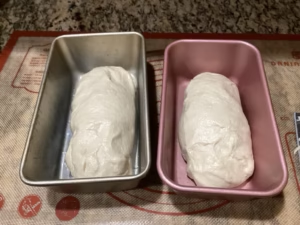
After the rise, I punched the dough down, divided it into two loaves, shaped them, and placed them in my loaf pans.
No complicated folds.
No fancy shaping techniques.
No second rise.
That last part almost felt wrong.
Every instinct I had said,
“Surely it needs another proof…”
The recipe basically replied,
“Nope. Into the oven.”
So into the oven they went.
The Moment of Truth
About an hour after I had started measuring flour…
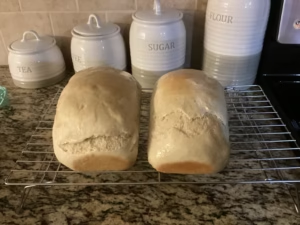
…I pulled two fully baked sandwich loaves from the oven.
I honestly laughed.
Not because they were perfect.
Because they actually worked.
So…How Was the Bread?
This isn’t artisan bread.
It isn’t trying to be.
You’re not going to get giant open holes, a crackling crust, or a loaf worthy of an Instagram bread influencer.
What you get instead is something that, quite honestly, many families will use far more often.
A wonderfully soft sandwich loaf.
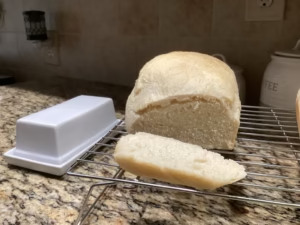
The crumb was fine, even, and completely baked through.
Because it’s an enriched dough made with olive oil and sugar, the texture is soft without being gummy. It sliced beautifully and would be perfect for:
- BLTs
- Peanut butter and jelly
- Grilled cheese
- Morning toast
- French toast
- Any sandwich that shouldn’t drip mayonnaise through giant artisan holes.
Sometimes boring is exactly what lunch needs.
Would I Change Anything?
Only one thing.
I’d score the tops before baking.
As you can see from my photos, both loaves naturally split near the front as they expanded in the oven.
That isn’t a failure.
Bread is simply going to expand somewhere.
A quick slash down the middle would probably give the loaf a cleaner, more intentional look next time.
Otherwise?
I’d leave the recipe exactly as it is.
Final Verdict
Speed: ⭐⭐⭐⭐⭐
Ease: ⭐⭐⭐⭐⭐
Flavor: ⭐⭐⭐⭐☆
Texture: ⭐⭐⭐⭐☆
Would I Make It Again?
Absolutely.
Would I replace my weekend artisan bread with this every time?
No.
Those long-fermented loaves still have a flavor and texture that’s hard to beat.
But when life gets busy…
When you forgot to buy bread…
When the family wants sandwiches…
Or when you simply don’t feel like waiting twelve hours for dough to decide it’s ready…
This recipe is honestly a little amazing.
🔧 Engineer’s Notes
- Total time (measured): 59 minutes
- Active hands-on time: About 10 minutes
- Number of bowls dirtied: One
- Number of times I questioned whether this would actually work: At least six.
- Number of slices left after lunch: Surprisingly few.
Full Credit Where Credit Is Due
This experiment was inspired by Robyn on the Farm’s One Hour Bread recipe.
If you’d like the complete ingredient list and instructions, I encourage you to watch her YouTube video and support her channel. She deserves the credit for creating a recipe that delivers exactly what it promises.
My goal wasn’t to recreate her work.
It was simply to answer one question.
Can you really make homemade bread in one hour?
My answer?
Yes.
And if you’ll excuse me, I have a BLT waiting.